
September 10, 2026
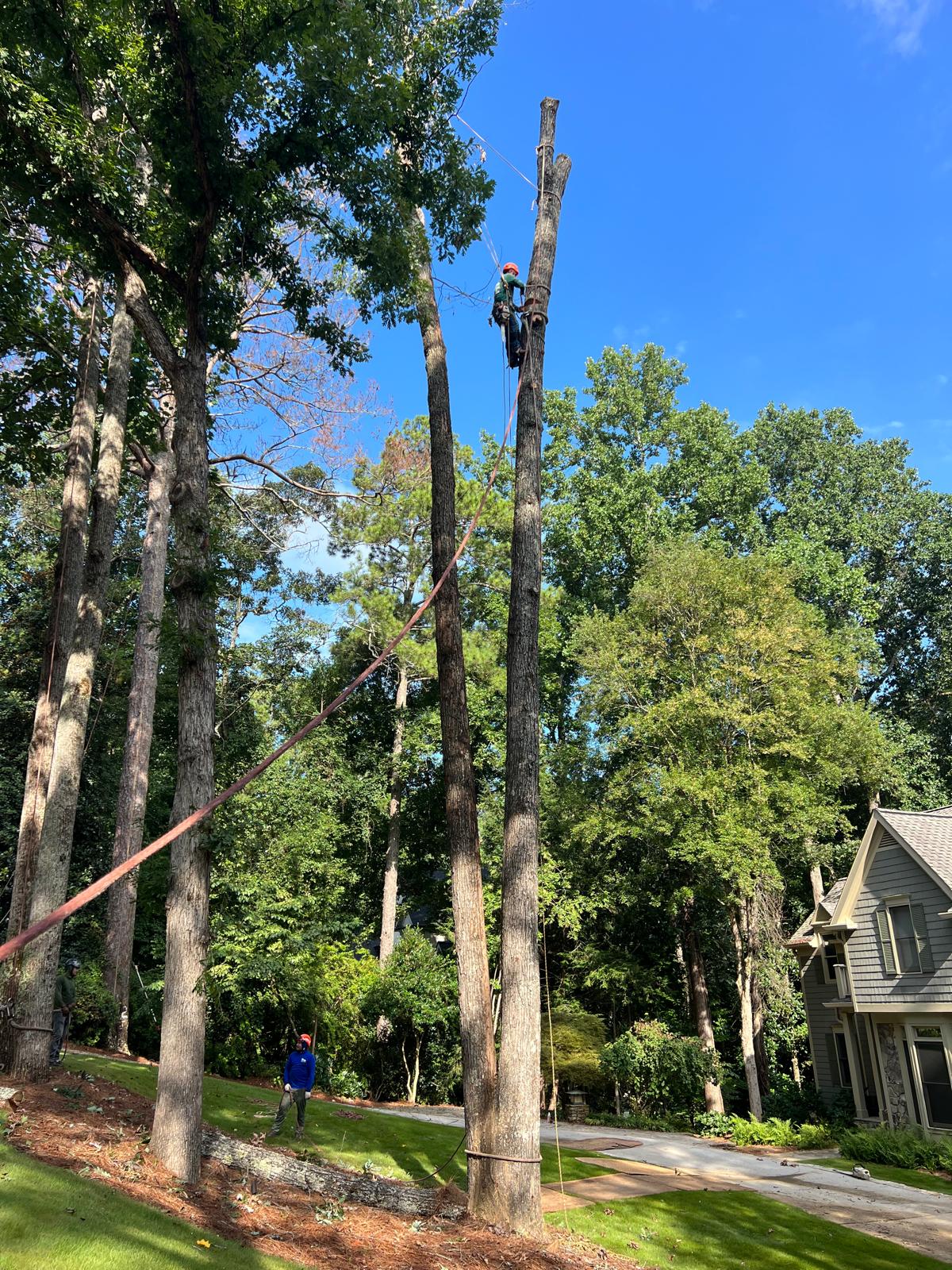
Georgia storms don't wait for a convenient time, and neither do the trees that come down in them. Every spring, we get calls the morning after high winds asking basically the same thing: was there any way to know that tree was going to fail? Usually, yes. A hazard tree almost always gives warning signs before it goes — the trick is knowing what to look for weeks or months ahead, not the night a storm is already rolling through North Georgia.
Not every imperfect tree is dangerous. A hazard tree specifically combines two things: a real structural weakness (dead wood, root damage, a crack, decay) and a "target" it could hit if it fails — your house, a car, a power line, a spot where your kids play. A perfectly healthy-looking oak out in the middle of a field with nothing under it isn't a priority. The same tree leaning ten degrees toward your bedroom window is.
Look up before you look at the trunk. Broken limbs that are cracked but still attached — arborists call them "widowmakers" for a reason — are some of the most dangerous parts of a hazard tree because they can drop with zero warning, no wind required. If you see broken branches tangled in the canopy rather than on the ground, don't try to knock them down yourself. This is exactly the kind of job where a crew comes in with climbing gear and rigging rather than a ladder and a pole saw, especially anywhere near power lines.
A tree that has always grown at a slight angle isn't necessarily a problem — some species just grow that way. What matters is a new lean, or soil that's cracked and pushed up on one side of the trunk. That's usually the root plate starting to let go, and it means the tree's whole support system is compromised, not just one branch. Trees in this condition can fail with very little additional wind. If you notice this after a heavy rain especially, treat it as urgent.
A vertical crack running down the trunk, a hollow cavity you can see or hear when you knock on the bark, or mushroom-like fungal growth (conks) at the base are all signs of internal decay. The tree can still be fully leafed out and green on top while the structural wood underneath has lost most of its strength — which is exactly the combination that catches people off guard, because the tree "looked fine" right up until it didn't.
A canopy that's grown heavily lopsided — usually from competing with a neighboring tree for light — puts a lot of weight on one side, which increases the chance of a major limb failure toward whatever's underneath. Same goes for large limbs extending directly over your roofline; even a moderate storm can turn one of those into thousands of dollars in damage. If your gutters are constantly full of small dead twigs, that's often a sign the tree is shedding weak wood on its own, which is worth having looked at even if nothing looks obviously broken yet.
The best time to deal with a hazard tree is a calm, dry day in late winter or early spring — before storm season ramps up, not during it. Once a strong system is forecast, tree crews across North Metro Atlanta get booked solid fast, and climbing a compromised tree in high wind is not something a responsible company will do regardless of how urgent it feels. Checking weather.gov or your local NOAA forecast office for the season's severe weather outlook is a good prompt to get an assessment scheduled before the calls start piling up.
If any of this sounds like a tree on your property, it's worth having it looked at rather than guessing. We offer free assessments and can tell you honestly whether you're looking at routine tree trimming or a case for full tree removal. For anything already leaning, cracked, or hanging over a structure, don't wait — our emergency tree service team handles exactly this kind of urgent call, day or night.
Homeowners in Woodstock, Roswell, and the rest of North Metro Atlanta deal with a specific mix of pines and hardwoods that fail in different ways — pines tend to snap, oaks and hickories tend to uproot — so local experience matters here. Check our service areas to confirm we cover your neighborhood, including tree service in Woodstock and tree service in Roswell.
For homeowners who want to learn more before calling anyone, the International Society of Arboriculture publishes solid consumer guidance on recognizing hazard trees, and the Tree Care Industry Association has a directory of accredited companies if you want a second opinion. The Georgia Forestry Commission also tracks storm damage patterns specific to our state and is a good resource if you're trying to understand why certain species fail more often in Georgia's clay soil, and the Arbor Day Foundation has a plain-language hazard tree checklist if you want to walk your yard with a list in hand. A hazard tree assessment costs nothing and takes twenty minutes — the alternative is finding out the hard way, usually at 2 a.m. during the next line of storms. Contact us and we'll get someone out to take a look.
Call (470) 403-0215 or fill out the form — we're available 24/7 for emergencies.